Cuban Missile Crisis (1962)
A confrontation over Soviet missiles in Cuba brought the United States and Soviet Union dangerously close to nuclear war.
CIVIL RIGHTS · SPACE · MUSIC · YOUTH · DESIGN
The 1960s transformed politics, culture, technology and everyday life—from civil rights and the Moon landing to the British Invasion, mod design and the counterculture.
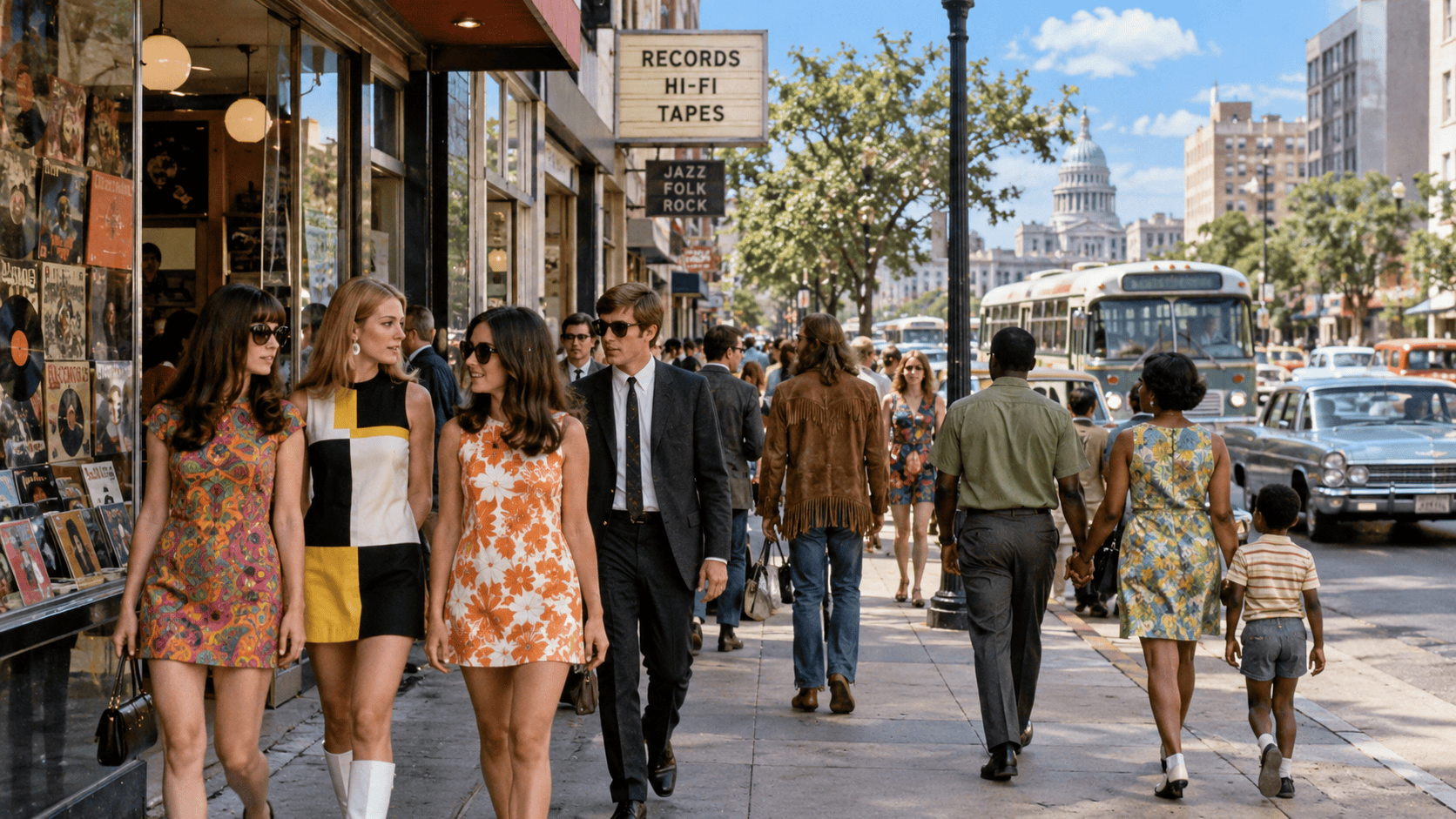
Overview
The 1960s brought dramatic social and cultural change. The civil rights movement reached a decisive period through mass organizing, landmark court decisions and federal legislation.
Women’s liberation gained momentum, while anti-war protests grew as American involvement in Vietnam expanded.
Politics moved through extraordinary shocks. John F. Kennedy’s presidency and assassination shaped the early decade, while Lyndon B. Johnson’s Great Society expanded the federal role in civil rights, education, health and poverty programs.
Technology advanced at spectacular speed. Satellites transformed communications and weather observation, computers became more important in business and research, and the Space Race culminated in the 1969 Moon landing.
Popular culture also shifted dramatically. The Beatles and other British bands changed pop music, Motown became a global force, television brought war and protest into the home, and Pop Art challenged ideas about fine art and mass culture.
Fashion mirrored the wider rebellion. Miniskirts, go-go boots, geometric mod clothing and futuristic synthetics existed alongside tie-dye, fringe, natural fabrics and hippie styles.
By 1969, the decade had changed the language of politics, youth culture, music, media, design and technological ambition.
Events
A confrontation over Soviet missiles in Cuba brought the United States and Soviet Union dangerously close to nuclear war.
The U.S. president was killed in Dallas, an event that deeply shocked the country and the wider world.
Hundreds of thousands gathered in Washington, D.C., for jobs and freedom during a defining civil rights demonstration.
U.S. military involvement in Southeast Asia expanded dramatically during the middle and later years of the decade.
Neil Armstrong and Buzz Aldrin became the first humans to walk on the Moon.
Resistance to a police raid at the Stonewall Inn became a landmark in the modern LGBTQ+ rights movement.
Israel fought Egypt, Jordan and Syria in a short conflict that transformed the political geography of the Middle East.
Reform efforts in Czechoslovakia were ended by a Warsaw Pact invasion.
The civil rights leader was killed in Memphis, prompting grief, protest and unrest across the United States.
A major coordinated offensive by North Vietnamese and Viet Cong forces changed perceptions of the Vietnam War.
East German authorities constructed a fortified barrier dividing East and West Berlin.
Mao Zedong launched a vast political and social campaign that disrupted institutions and daily life.
A total artificial heart was implanted as a temporary bridge to transplantation in Houston.
Major oil-exporting nations established the Organization of the Petroleum Exporting Countries.
The conflict over the attempted secession of Biafra continued into 1970.
The influential Black nationalist leader was killed in New York City.
The educational children’s television program began broadcasting in the United States.
A collapsing colliery spoil tip in Wales buried a school and nearby buildings.
A fatal car accident involving Senator Edward Kennedy became a major political controversy.
The landmark U.S. law prohibited discrimination in major areas of public life and employment.
03 / Inventions
Technology in the 1960s crossed boundaries between medicine, communications, computing, materials science and space exploration.
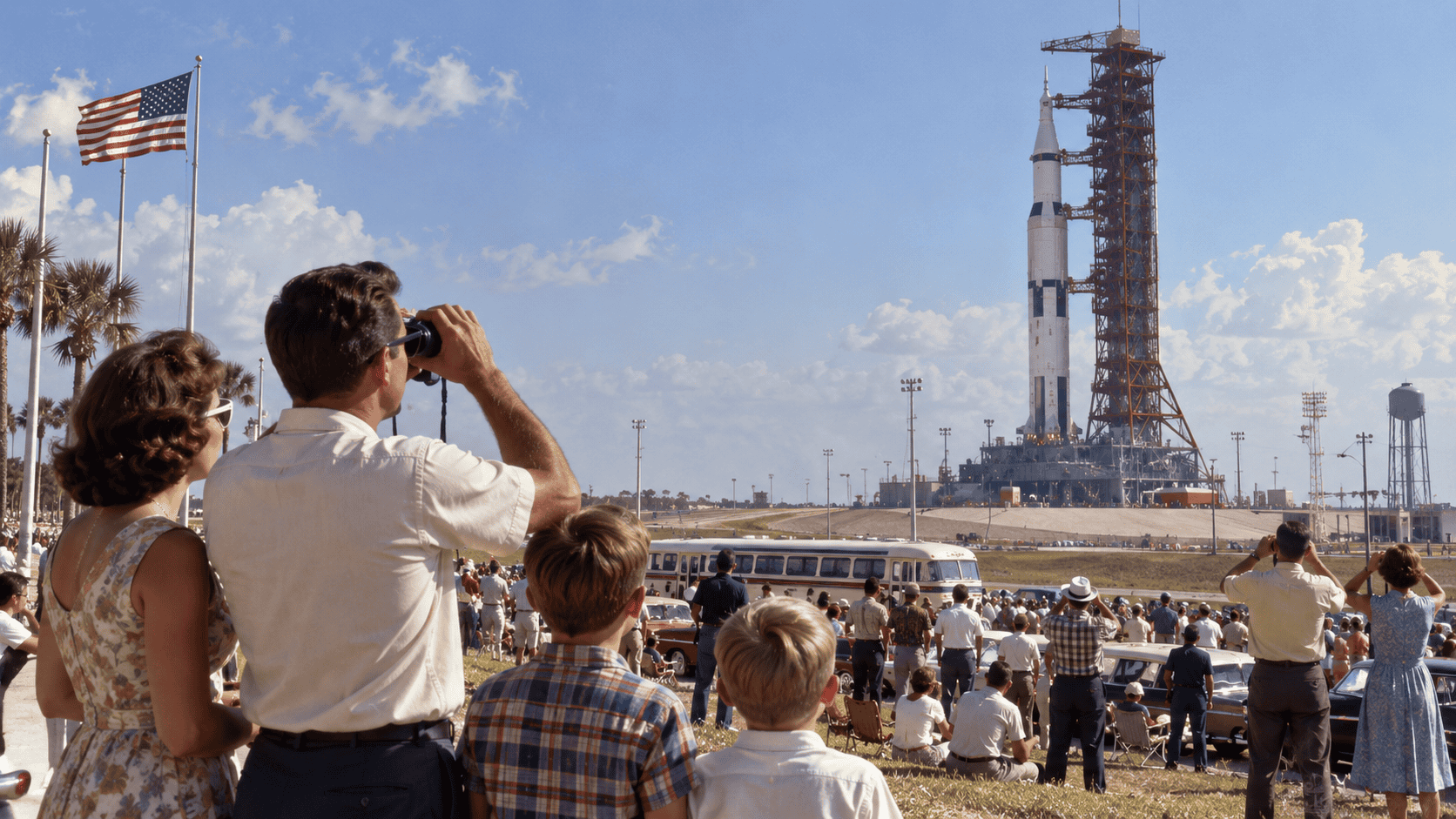
In 1969, doctors used a total artificial heart to keep a patient alive until a donor heart became available.
Cash-dispensing machines entered public use during the decade, pointing toward modern ATM banking.
Douglas Engelbart’s research team developed the mouse as a practical way to interact with information on a screen.
The network connected its first nodes in 1969 and became an important predecessor of the modern internet.
Stephanie Kwolek developed the extraordinarily strong synthetic fiber in 1965.
Practical visible-spectrum light-emitting diodes emerged in the early 1960s.
A compact battery-powered electronic calculator prototype demonstrated how computation could move beyond the desktop.
Synthetic turf became famous after installation at Houston’s Astrodome.
The specialized spacecraft carried astronauts from lunar orbit to the Moon’s surface.
Gary Starkweather’s 1969 work at Xerox created the foundation of laser printing.
Originally conceived for decorative wall covering, the material found a far more successful use as protective packaging.
Ted Nelson popularized the term for linked, non-linear electronic text.
Commercial soft lenses helped make vision correction more comfortable for many users.
Douglas Engelbart’s 1968 demonstration showed windows, hypertext, collaborative editing and mouse-driven interaction.
TIROS-1 launched in 1960 and demonstrated the value of satellite weather observation.
Telstar 1 relayed television and communications signals across the Atlantic in 1962.
Machine-readable coding systems were tested in transport and industrial applications.
Battery-powered drills made portable electric tools increasingly practical.
Synthetic polyester fabrics became highly visible in mass-market fashion.
Wrinkle-resistant treatments made low-maintenance clothing increasingly popular.
04 / Culture
The decade’s culture was not one movement but a collision of civil rights, Pop Art, feminism, youth rebellion, new media and counterculture.
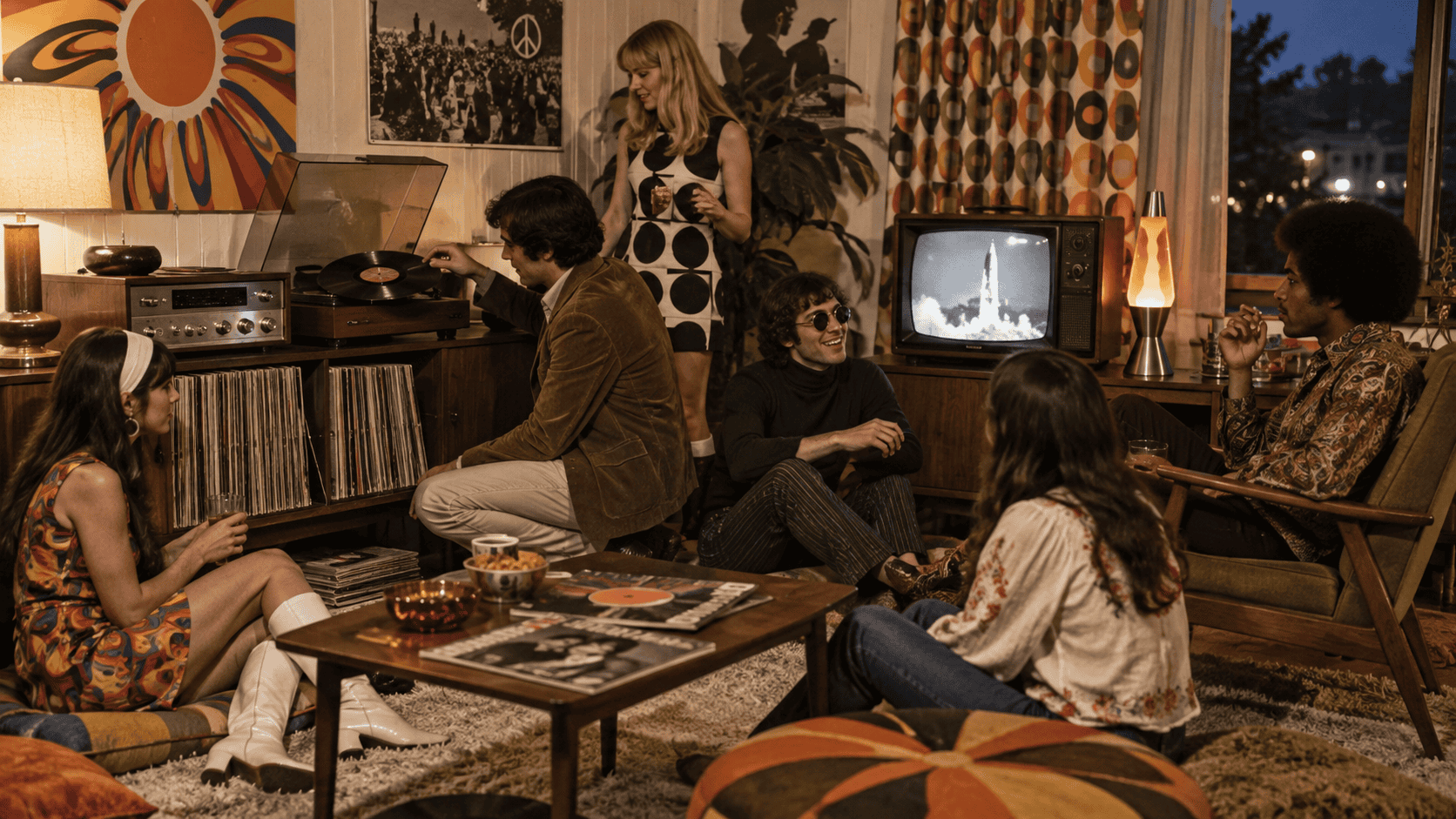
Counterculture communities emphasized peace, experimentation, communal values and personal freedom.
Campaigns against segregation and voter suppression transformed American law and public life.
Women’s liberation movements challenged discrimination, workplace inequality and traditional gender expectations.
Artists turned advertising, consumer objects and celebrity imagery into subjects for fine art.
Concern over pollution, pesticides and ecological damage grew rapidly.
Competition between the United States and Soviet Union made space exploration a central public spectacle.
Writers and artists associated with the Beat Generation continued influencing younger countercultures.
Teenagers and young adults gained greater influence over fashion, music, media and consumer markets.
Attitudes toward relationships, contraception and sexuality changed significantly.
Swirling forms, saturated color and optical distortion became instantly recognizable visual styles.
Independent newspapers and magazines carried radical politics, music coverage and countercultural ideas.
Student and activist movements developed new forms of protest around war, civil rights and social change.
The movement emphasized racial pride, community control and self-determination.
Some counterculture participants experimented with shared living and collective ownership.
Psychedelic drugs became closely associated with parts of music, art and youth culture.
Television dinners and packaged foods reflected a broader shift toward convenience in the home.
The fashion doll became a major part of childhood consumer culture during the decade.
Marches, sit-ins and demonstrations became familiar forms of political action.
British youth style combined scooters, sharp tailoring, modern design and rhythm-and-blues influenced music.
The anti-nuclear design became an international emblem of peace and anti-war activism.
05 / America
Haight-Ashbury became one of the best-known centers of the hippie counterculture.
The automobile industry remained powerful while Motown Records reshaped American popular music.
NASA’s Manned Spacecraft Center made the city central to the U.S. space program.
Surf culture, film, television and a rapidly changing music scene gave the city enormous cultural influence.
Civil rights campaigns, urban politics and the 1968 Democratic National Convention placed the city in the national spotlight.
Greenwich Village folk, Pop Art, publishing, television and the Stonewall uprising all shaped the city’s cultural role.
Casino resorts and headline entertainment expanded the city’s national profile.
Civil rights marches, federal reform and anti-war protest made the capital a stage for social conflict.
A growing Cuban exile community transformed politics, business and culture.
The Space Needle and the 1962 World’s Fair gave the city a futuristic international image.
Universities and student movements made the city a major center of activism.
Country music recording and publishing continued expanding.
The city was both a major civil rights center and a growing business hub.
Jazz preservation and tourism helped protect the identity of the French Quarter.
The Free Speech Movement turned the university city into a symbol of student activism.
Florida launch complexes became synonymous with the American space program.
The San Francisco neighborhood became a global shorthand for the Summer of Love.
The town lent its name to the famous 1969 festival held nearby in Bethel.
Voting-rights marches in Alabama became decisive events in the civil rights struggle.
The city became inseparable from soul music and the 1968 assassination of Martin Luther King Jr.
06 / Fashion
1960s style changed rapidly—from polished early-decade tailoring to London mod, futuristic synthetics, psychedelic prints and the relaxed influence of the counterculture.
Short hemlines became one of the decade’s strongest symbols of youth fashion.
White and brightly colored knee-high boots were closely associated with mod style and dance culture.
Flared trousers moved from niche style toward a defining late-1960s silhouette.
Hand-dyed swirling color became closely associated with hippie fashion.
Mandarin-collar jackets reflected Western fascination with South Asian design.
Small structured hats became strongly associated with polished early-decade fashion.
The curved teardrop motif appeared across shirts, dresses and accessories.
Clean geometry, short dresses and sharp tailoring reflected the influence of Swinging London.
Intense colors and fluid patterns translated psychedelic art into clothing.
Designers experimented with metallics, plastics, vinyl and futuristic silhouettes.
Natural hair became an important expression of Black pride and identity.
Two-piece swimsuits became increasingly mainstream in youth and beach culture.
Tailored trousers challenged conventional expectations of women’s public dress.
Shiny synthetic materials captured the decade’s fascination with modern technology.
Leather and suede fringe became part of hippie and folk-inspired dressing.
Large geometric fields of contrasting color became a signature mod look.
Long stockings paired naturally with increasingly short hemlines.
Slim ankle boots with Cuban heels became part of the British Invasion look.
Disposable novelty garments briefly captured the decade’s fascination with new materials.
High-necked knitwear fit equally well into beatnik, intellectual and mod wardrobes.
07 / Movies
Epic spectacle, horror, spy films, counterculture stories and increasingly daring crime dramas made the decade a bridge between classical Hollywood and a new generation of filmmaking.
Stanley Kubrick’s science-fiction epic combined technical realism with philosophical mystery.
The coming-of-age drama captured generational uncertainty and social discomfort.
The crime film pushed Hollywood toward a more modern style of editing, violence and antihero storytelling.
The road movie became a lasting cinematic emblem of the counterculture.
Alfred Hitchcock’s thriller changed expectations for mainstream horror and suspense.
David Lean’s historical epic became celebrated for scale, landscape photography and performance.
Sergio Leone’s western turned stylized violence and Ennio Morricone’s music into a global phenomenon.
The romantic comedy became one of the decade’s most recognizable style films.
Kubrick’s black comedy satirized nuclear strategy and Cold War logic.
Science fiction became a vehicle for questions about society, power and human nature.
Psychological horror moved into unsettling domestic territory.
The musical became one of the decade’s biggest popular successes.
The drama brought interracial marriage into mainstream Hollywood discussion.
Low-budget horror created a new model for zombie cinema.
Michelangelo Antonioni used mystery to explore perception, images and Swinging London.
Disney’s animated adaptation became one of the studio’s best-known 1960s releases.
The crime drama confronted racial tension through a murder investigation in Mississippi.
Clint Eastwood’s breakthrough western helped introduce a new international style of the genre.
Sam Peckinpah’s western brought a darker and more violent tone to the end of the decade.
The James Bond film helped establish the visual language of the modern spy blockbuster.
08 / Music
Rock, soul, Motown, folk and psychedelia crossed borders, while concerts and festivals turned music into a shared identity for millions of young people.
The British band transformed global popular music and led the British Invasion.
The 1969 festival became a lasting symbol of counterculture and rock culture.
Studio experimentation, extended forms and surreal imagery reshaped rock music.
Detroit’s hit-making label brought soul and pop records to a massive international audience.
His songwriting connected folk traditions with new political and literary ambitions.
Blues-based rock, rebellious image and major songwriting success made the band central to the decade.
His electric guitar technique and stagecraft expanded ideas about what rock performance could be.
Gospel intensity and rhythm-and-blues grooves powered one of the decade’s defining sounds.
Intricate harmonies and increasingly ambitious studio work expanded American pop.
Her raw blues-influenced voice became one of counterculture rock’s most recognizable sounds.
Electric bands combined rock instrumentation with folk songwriting traditions.
The Los Angeles band mixed blues, psychedelia, theater and dark poetry.
Her commanding voice made her one of the decade’s defining soul artists.
The 1967 festival brought major attention to a new generation of rock performers.
Explosive live shows and ambitious songwriting placed the band at the center of British rock.
The band became closely associated with San Francisco counterculture and extended live improvisation.
The duo brought sophisticated harmonies and folk-rock songwriting to a mass audience.
Rhythmic innovation and dynamic performance laid crucial foundations for funk.
The New York group’s experimental rock became enormously influential despite limited initial sales.
The Memphis label became a major center of Southern soul and rhythm and blues.
09 / Cars
Introduced in 1964, the Mustang created enormous demand for sporty, affordable pony cars.
Chevrolet launched the Camaro as a direct rival to the Mustang.
The GTO became one of the foundational cars of the American muscle-car era.
Compact size, front-wheel drive and racing success made the British car a design icon.
The van became closely associated with travel, youth culture and the hippie movement.
Introduced in the 1960s, the rear-engined sports car established a design that would evolve for decades.
The second-generation Corvette combined dramatic styling with serious performance.
Introduced in 1966, the compact car helped establish Toyota as a major global manufacturer.
Its mid-engine layout and dramatic styling helped define the modern supercar.
American Motors entered the pony-car market with a distinctive fastback design.
The large fastback became one of the most recognizable American performance cars.
The elegant mid-engined sports car broadened Ferrari’s road-car identity.
Introduced in 1964, it was among the earliest American pony cars.
The full-size Chevrolet remained one of the decade’s most familiar American cars.
Designed to challenge Ferrari at Le Mans, the race car became a legend of endurance competition.
Its long hood and sleek profile made it one of the decade’s most celebrated sports-car designs.
The luxury coupe revived front-wheel drive in a modern American road car.
The Japanese sports car became the first series-built automobile with a two-rotor Wankel engine.
The personal luxury coupe combined restrained styling with powerful American engines.
Introduced in 1969, the Japanese sports car combined attractive styling, performance and value.
10 / Legacy
The 1960s changed the meaning of citizenship, youth, protest and popular culture. Civil rights legislation transformed American law, while feminist, LGBTQ+ and anti-war movements widened debates about freedom and equality.
The decade also changed how people imagined technology. Satellites, interactive computing and lunar exploration made advanced science part of everyday public conversation.
In music, design, cinema and fashion, the 1960s rewarded experimentation and made youth culture a lasting economic and cultural force.
11 / FAQ
The decade is remembered for the civil rights movement, the Vietnam War, the Space Race, the Moon landing, the counterculture, the British Invasion, second-wave feminism and major changes in fashion and media.
Large youth populations, civil rights organizing, expanding television coverage, changing gender expectations and opposition to the Vietnam War all accelerated social change.
Satellites, integrated electronics, the computer mouse, ARPANET, laser printing and Apollo spacecraft all pointed toward new forms of communication, computing and exploration.
Rock, soul, Motown, folk rock, psychedelic music and the British Invasion all played major roles.
Early-decade polish gave way to mod miniskirts, go-go boots, geometric prints, pantsuits, psychedelic fabrics, tie-dye and hippie-influenced styles.
The decade reshaped civil rights, youth politics, popular music, television, design, gender roles and society’s relationship with science and technology.